What Is Answer Engine Optimization (AEO)? How It Differs From SEO
On this page
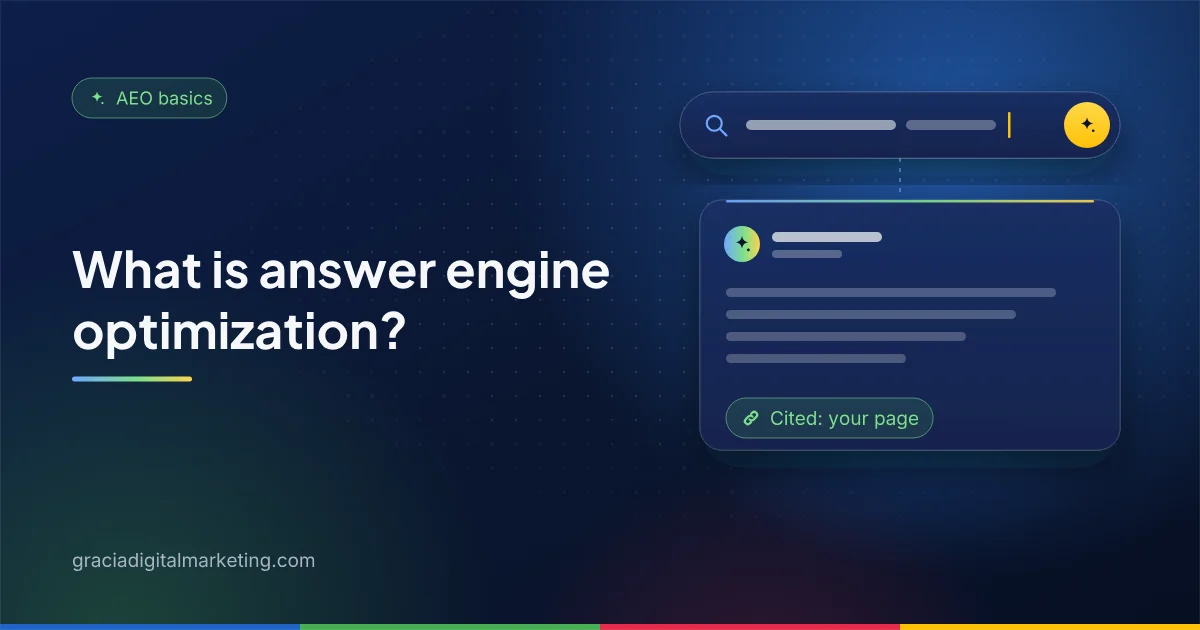
Answer engine optimization (AEO) is the practice of making your content easy for AI-powered answer engines, such as Google AI Overviews and AI Mode, ChatGPT search, Perplexity, Gemini and Microsoft Copilot, to find, understand, trust and cite. It builds on SEO rather than replacing it: the same crawlable, helpful pages earn both rankings and citations.
Buyers increasingly type full questions into search boxes and AI assistants and get a written answer back, with a handful of linked sources. If your company is one of those sources, you are part of the conversation before a buyer ever visits a website. If you are not, a competitor is. This guide explains what AEO means in practice, how it relates to SEO and generative engine optimization (GEO), and what the search engines themselves say about it.
What does answer engine optimization mean?
An answer engine responds to a question with a synthesized answer and supporting links instead of a plain list of results. AEO is the work of making your pages the sources those answers rely on and link to.
Classic search returns a ranked list and lets the searcher do the reading. Answer engines do part of the reading for them. They retrieve pages, summarize what those pages say and show links to the sources behind the summary. Google describes AI Overviews as a way to get to the gist of a complicated topic quickly, and AI Mode as particularly helpful for queries that need further exploration, reasoning or complex comparisons.
That shift changes the question marketers ask. It is no longer only “do we rank for this keyword?” but also “when a buyer asks this question, does the answer mention us, describe us accurately and link to us?”
How is AEO different from SEO?
The foundations are the same; the unit of success changes. SEO measures rankings and clicks for pages. AEO also measures whether your brand and pages are cited, and described correctly, inside AI-generated answers.
| Dimension | Classic SEO | AEO lens |
|---|---|---|
| Main goal | Rank pages and earn clicks | Be cited and described accurately in answers |
| Unit of work | Keyword and page | Question, passage and entity (your brand, products, people) |
| Typical query | Short keyword phrases | Longer, conversational, multi-part questions |
| Success signals | Rankings, clicks, conversions | Citations, AI impressions, mention accuracy, assisted pipeline |
| Shared foundations | Crawlable and indexed pages, helpful people-first content, clear structure, accurate structured data, trustworthy site | |
It is worth being clear about how the engines themselves see this. Google’s guide to optimizing for generative AI search says that, from Google Search’s perspective, optimizing for generative AI search “is optimizing for the search experience, and thus still SEO.” Bing’s Webmaster Guidelines make the same point from Microsoft’s side: the fundamentals that help pages rank also help them get selected to ground answers in Bing and Copilot.
So treat AEO as a sharper focus within good SEO, not as a parallel discipline with its own tricks. You can read more about how we approach that combined work on our SEO services page.
How do AEO, GEO and SEO fit together?
SEO earns visibility in search results, AEO earns the direct answer to specific questions, and GEO looks at your overall presence across generative AI responses. In practice they share one technical and content foundation.
- SEO makes your site crawlable, indexable and relevant, and earns rankings in classic results.
- AEO shapes content so that it directly and accurately answers the questions buyers ask, which makes it easy to cite.
- GEO (generative engine optimization) looks across AI experiences at how often, and how well, your brand is represented. Microsoft, for example, describes its AI Performance report in Bing Webmaster Tools as an early step toward GEO tooling.
The labels overlap and different agencies draw the lines differently. What matters is the work underneath. If you want the GEO side in more depth, see our GEO services.
How do answer engines choose which sources to cite?
Most answer engines retrieve pages from a search index at the moment a question is asked, then generate an answer grounded in those pages. If you are not crawlable and indexed by that engine, you cannot be cited.
Google explains that AI Overviews and AI Mode may use a “query fan-out” technique, issuing multiple related searches across subtopics to build a response, and that a page must be indexed and eligible to show a snippet to appear as a supporting link. ChatGPT search relies on OpenAI’s OAI-SearchBot crawler, Perplexity on PerplexityBot, and Copilot on the Bing index. We cover each engine in how to get cited by ChatGPT, Perplexity, Gemini and Copilot.
Once a page can be retrieved, the familiar quality questions take over. Does it answer the question better than the alternatives? Is it clear who wrote it and why they can be trusted? Are the facts consistent with what the rest of the web says about you?
What does good AEO work include?
Six workstreams cover most of it: question research, answer-first content, entity clarity, accurate structured data, crawler access and measurement.
- Question research. Collect the real questions buyers ask from sales calls, support tickets, Search Console queries and forums, not only keyword tools.
- Answer-first content. Lead each section with a direct answer, then add depth, evidence and examples. See our guide to writing answer-first content.
- Entity clarity. Describe your company, services and people the same way everywhere. See entity SEO for AEO.
- Structured data that matches the page. Organization, Article and Breadcrumb markup help machines read your site, but they never replace visible content. See schema markup for AEO.
- Crawler access. Make sure robots.txt, your CDN and your firewall let the search crawlers of each engine in. See our AI crawler guide.
- Measurement. Track AI impressions and citations next to rankings and pipeline. See how to measure AEO.
What is AEO not?
AEO is not a set of hidden tricks. Google explicitly says you can ignore several popular “AI optimizations” for its Search, and both Google and Bing treat manipulation as spam.
Google’s guide lists things you can ignore for Google Search: special files such as llms.txt, breaking content into tiny “chunks”, rewriting content just for AI systems, chasing inauthentic mentions and overfocusing on structured data. Bing’s guidelines warn against keyword stuffing and against hidden instructions aimed at AI systems, sometimes called prompt injection. Google also notes that its spam policies apply to generative AI responses too.
A useful test: if a tactic would embarrass you when a buyer saw it, it is not AEO worth doing.
Is AEO worth it for B2B companies?
For most B2B companies, yes. B2B questions are often complex and comparative, which is exactly where AI answers tend to appear and where being cited can put you on a shortlist.
B2B buyers ask questions like “what should a mid-size manufacturer look for in an ERP integration partner?” or “how do SOC 2 Type I and Type II differ?”. Google says AI Mode is designed for nuanced questions that might previously have taken multiple searches. If your pages answer those questions with real expertise, you give answer engines a reason to cite you. If you work in software, our AEO playbook for B2B SaaS goes deeper.
The honest caveat: no one can guarantee a citation. Engines choose sources per question, answers vary from one session to the next, and Google notes that AI Overviews often do not trigger at all. AEO improves your odds; it does not buy placement.
Where should you start with AEO?
Start with a baseline: confirm the engines can crawl and index you, list your top buyer questions, and check how AI answers describe you today.
- Check robots.txt and firewall rules for Googlebot, Bingbot, OAI-SearchBot, PerplexityBot and Claude-SearchBot.
- Confirm your key pages are indexed in Google Search Console and Bing Webmaster Tools.
- Write down 20 to 30 questions your buyers actually ask, grouped by funnel stage.
- Ask those questions in the main AI assistants and note who is cited and whether facts about you are right.
- Fix the gaps in order: access first, then the pages that should answer your highest-value questions.
Our AEO audit checklist turns this into a step-by-step review. If you would rather have us look, request a free SEO and AEO audit or read how our AEO services work.
Frequently asked questions
Is AEO the same as SEO?
Not quite, but it is built on SEO. Google says that optimizing for its generative AI search is still SEO, and Bing says SEO fundamentals apply to AI answers. AEO is a lens on that work: it focuses on questions, direct answers, entity clarity and being cited, not only on rankings and clicks.
Which answer engines does AEO cover?
The main ones for B2B buyers are Google AI Overviews and AI Mode, ChatGPT search, Perplexity, Gemini, Microsoft Copilot and Claude. Each uses its own index or crawler, so crawl access and indexing are checked engine by engine.
Do I need a separate AEO strategy?
Usually not a separate one. Most companies get further by adding AEO goals to their existing SEO and content plan: answer real buyer questions clearly, keep facts consistent, allow the right crawlers and measure citations alongside rankings.
How long does AEO take to show results?
There is no fixed timeline. Technical fixes such as unblocking a crawler can matter within days, because some engines say they adjust to robots.txt changes in about 24 hours. Earning citations for competitive questions depends on content quality and authority, so plan in quarters, not weeks.
Can a small B2B company compete in AI answers?
Yes, especially on specific questions. AI answers often draw on several sources, and a focused page that answers a niche question well can be cited next to much larger brands.
Sources
- Google Search Central: Optimizing your website for generative AI features on Google Search
- Google Search Central: AI features and your website
- Bing Webmaster Guidelines
- Bing Webmaster Blog: Introducing AI Performance in Bing Webmaster Tools (February 2026)
- OpenAI: Overview of OpenAI crawlers
- Google Search Central: Spam policies for Google web search