Entity SEO for AEO: Make Your Brand Unambiguous to AI
On this page
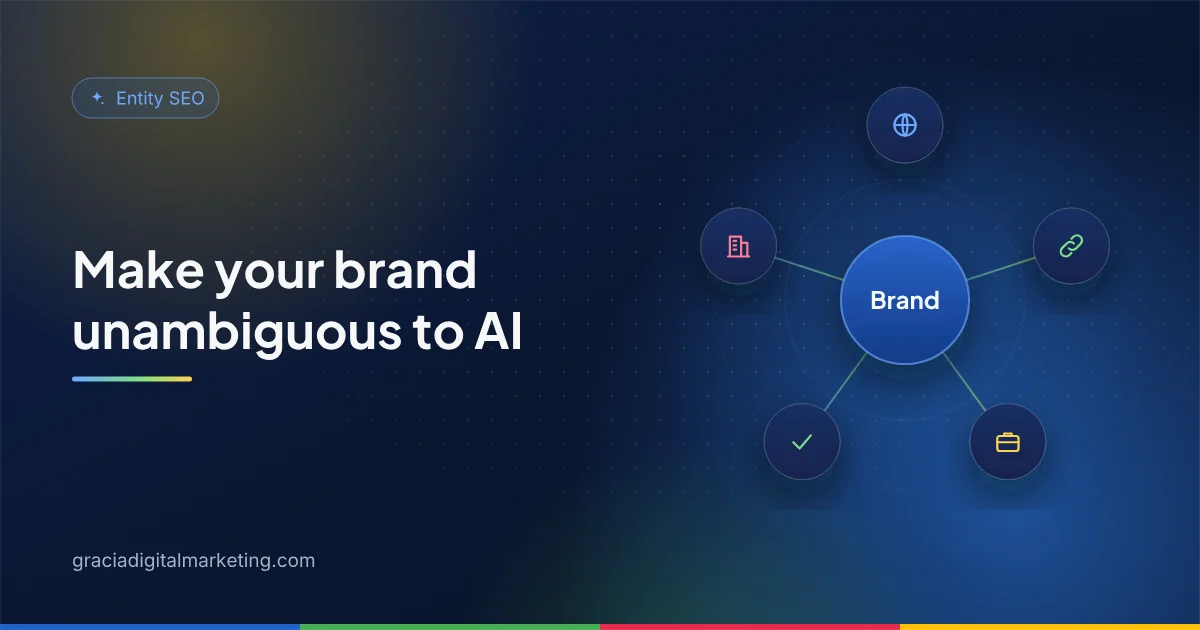
Entity SEO is the work of making your company, products and people unambiguous to search engines and AI systems. You do it by describing them consistently everywhere, connecting your official profiles with Organization schema and sameAs links, and earning genuine third-party mentions, so answer engines can recognize you and describe you correctly.
When a buyer asks an AI assistant “which agencies help B2B SaaS companies with AI search?” or “what does Acme Analytics do?”, the system has to decide which real-world company each name refers to and what is true about it. If your name is generic, your descriptions vary from page to page, or your profiles disagree, you make that job harder. Entity SEO removes the ambiguity.
What is an entity, and why does it matter for AEO?
An entity is a distinct thing, such as a company, product, person or place, that facts can be attached to. Answer engines build answers around entities, so a well-defined entity is easier to cite accurately.
Classic keyword SEO matched words on a page to words in a query. Modern search and AI systems also try to understand which things a page is about. Bing’s Webmaster Guidelines recommend defining entities clearly and consistently so content can be used in AI answers. Google’s Organization structured data documentation says some properties are used behind the scenes to tell organizations apart, while others can influence what appears in results, such as your logo and knowledge panel.
What makes a brand entity ambiguous?
Inconsistent names, generic names shared with other companies, conflicting descriptions and stale profiles are the usual culprits.
- Your legal name, trading name and logo text differ, and pages use them interchangeably.
- Your home page says “digital transformation partner”, LinkedIn says “IT consultancy” and a directory says “software reseller”.
- Old profiles still show a former address, product name or leadership team.
- Another company with a similar name operates in a nearby category.
- Product names are used without saying they belong to your company.
How do you define your entity on your own site?
Choose one canonical description, use it consistently, and make your About page and Organization markup the definitive source.
- Write a one-sentence definition. Who you are, what you do and for whom: “Example Analytics builds revenue forecasting software for B2B finance teams in North America.” Use the same core sentence on your home page, About page, social profiles and directories.
- Make the About page an entity home. Include your full name, what you offer, where you operate, who leads the company and how to contact you. Link to official profiles.
- Add Organization markup with a stable @id. Include name, URL, logo, description, contact details and sameAs links, and reference the same @id as publisher on articles. See schema markup for AEO.
- Define products and services clearly. Give each its own page, say it is offered by your company, and describe it the same way across the site.
- Name the people. Where real people write or lead, show their names, roles and relevant experience. Where content is a team effort, say so honestly.
Which external signals help define your entity?
Official profiles you control, consistent business listings, and genuine coverage by others. Each one should repeat the same core facts.
| Signal | What to check | Who usually owns it |
|---|---|---|
| Search Console and Bing Webmaster Tools | Both sites verified; correct preferred domain | Marketing or web team |
| Google Business Profile | Category, service areas, website link, description | Marketing |
| LinkedIn company page | Name, tagline, industry, website and size match your site | Marketing or HR |
| Industry directories and marketplaces | Same description and categories; no duplicates | Marketing or partnerships |
| Partner and integration pages | Current product names and links | Partnerships |
| Press, podcasts and industry publications | Accurate company description in coverage | Leadership and PR |
| Wikidata or Wikipedia | Only where you genuinely meet notability rules | Independent editors, not you |
Google’s guide to establishing business details recommends verifying your site in Search Console and claiming your Business Profile, and explains that Google finds information such as your site name, corporate contact details and social profiles from publicly available sources. If you serve clients at their locations rather than from an office, a service-area Business Profile with a hidden address is the honest way to show it.
Should you create a Wikidata entry?
Only if your company genuinely meets Wikidata’s notability criteria. Creating promotional entries for companies that do not meet them tends to fail and can look manipulative.
Wikidata accepts items that have a valid link to a Wikimedia project page, refer to a clearly identifiable entity that can be described using serious and publicly available references, or fulfil a structural need. Many small and mid-size B2B companies do not qualify yet, and that is fine. Coverage in respected industry publications and consistent official profiles do more for most businesses.
How do third-party mentions fit in?
Genuine mentions corroborate who you are. Manufactured ones do not help, and Google warns that seeking inauthentic mentions is not as useful as it seems.
Google’s AI optimization guide notes that its AI features can reflect what is said about products and services across blogs, videos and forums, but that its ranking systems focus on quality and its spam systems apply to AI responses. The sustainable route is the old one: do work worth talking about, contribute expertise to industry publications and events, support partners with accurate descriptions of what you do together, and make it easy for journalists to get your facts right.
How do you check how AI describes your brand?
- Ask the main assistants simple questions: “What is [company]?”, “What does [company] do?”, “Who are [company]’s competitors?”
- Record the description, the sources cited and any factual errors.
- Trace each error to its likely source: an old page, a directory listing or an outdated article.
- Fix what you control first, then request corrections from third parties.
- Repeat monthly; answers change as models and indexes refresh. Our guide to measuring AI search visibility covers how to log this.
Entity work is part of our GEO services, because it shapes how AI systems describe you across every engine. It also underpins AEO and classic SEO. If you want to see where your brand stands today, start with a free audit, or read our AEO audit checklist.
Frequently asked questions
What is an entity in SEO?
An entity is a distinct, identifiable thing such as a company, product, person or place. Search engines and AI systems connect facts to entities, so a clearly defined brand entity is easier to describe accurately in answers.
How do I know if Google recognizes my company as an entity?
Signs include a knowledge panel for branded searches and an entry when you query Google’s Knowledge Graph Search API for your name. Google notes the API is read-only and not meant as a production-critical service, so treat it as a quick check.
Should my company create a Wikidata or Wikipedia entry?
Only if it genuinely meets their notability rules. Wikidata, for example, requires items to have a valid link to a Wikimedia page, describe a clearly identifiable entity documented in serious public sources, or meet a structural need. Self-promotional entries are often removed.
What is sameAs in schema markup?
sameAs is a schema.org property that lists URLs of pages that unambiguously identify the same entity, such as your official LinkedIn page or GitHub organization. It helps connect your website to your other official profiles.
Does a service-area business without an office need a Google Business Profile?
A Business Profile can be set up for a service-area business that serves customers at their locations, with the address hidden. It is one of the main ways Google confirms a real business, its category and the areas it serves.
Sources
- Bing Webmaster Guidelines
- Google Search Central: Organization structured data
- Google Search Central: Establish your business details with Google
- Google: Knowledge Graph Search API
- Schema.org: sameAs
- Wikidata: Notability
- Google Search Central: Optimizing your website for generative AI features on Google Search