Schema Markup for AEO: What Still Matters After FAQ Rich Results
On this page
Schema markup for AEO still matters, but not as a shortcut. Google says its AI features need no special structured data, and it stopped showing FAQ rich results in May 2026. Accurate Organization, Article and Breadcrumb markup that matches visible content still helps search engines and AI systems understand who you are and what each page covers.
Structured data has been sold as an AI visibility hack for years. The reality in 2026 is more modest and more useful. This guide explains what changed, what Google and Bing actually say, and which types are worth maintaining on a B2B website.
What changed for FAQ schema in 2026?
Google added a deprecation notice to its FAQ rich result documentation in May 2026, stopped showing FAQ rich results from May 7, 2026, and removed the documentation in June 2026.
For years, FAQPage markup could earn expandable questions under a search result. That feature is gone. Valid FAQPage markup will no longer change how your result looks in Google. It is still a schema.org type, other systems can read it, and the visible FAQ section itself can still be useful to readers. But anyone promising FAQ rich results in Google today is out of date.
Does structured data help with AI answers?
Google: not required and no special markup needed for AI features, though it remains part of good SEO. Bing: it may support clearer grounding when it reflects visible content, without guaranteeing inclusion.
Google’s AI optimization guide lists “overfocusing on structured data” among things you can ignore for generative AI search, while recommending you keep using structured data as part of your overall SEO because it helps with rich result eligibility. Google’s AI features page adds one requirement worth repeating: make sure your structured data matches the visible text on the page.
Bing’s Webmaster Guidelines are slightly warmer. They suggest structured data can help Bing understand content when grounding answers, while making clear that it does not guarantee inclusion and must reflect what users actually see on the page.
Microsoft’s advertising team made a similar point in an October 2025 guide to inclusion in AI search answers: schema labels content as a product, review, FAQ or event so systems can interpret it, but it works alongside clear headings and self-contained writing, not instead of them.
The practical takeaway is the same from all of them: use schema to describe your pages precisely, never to claim things the page does not say.
Which schema types should a B2B site keep?
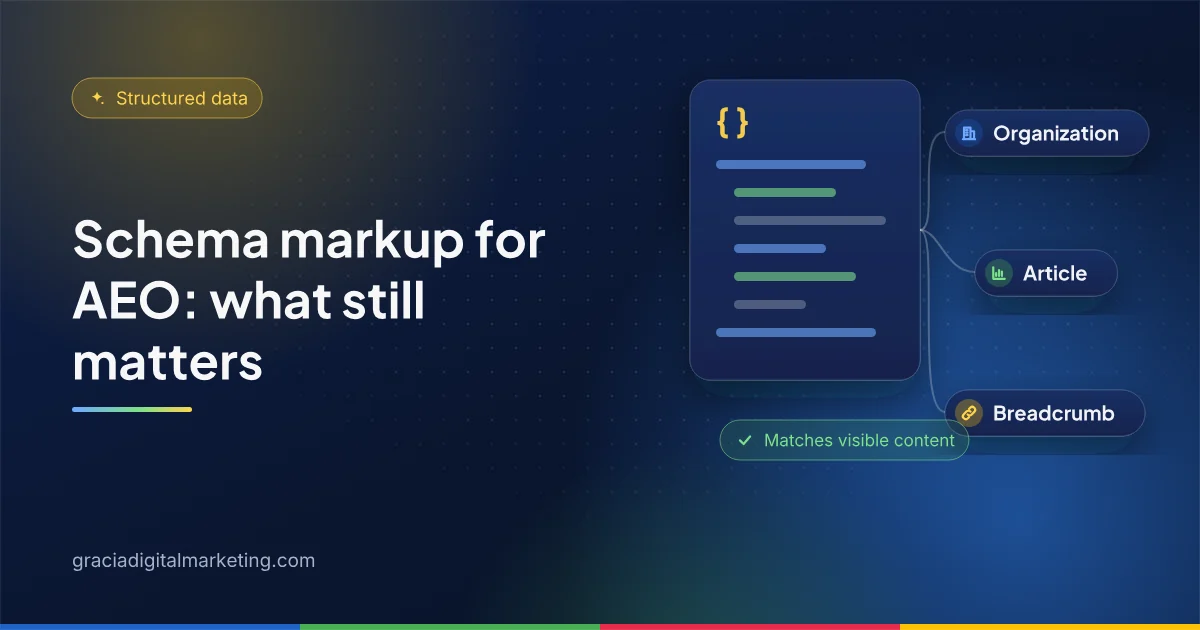
Organization, WebSite, BreadcrumbList and Article or BlogPosting cover most needs. Add other types only where they describe real, visible content.
| Type | Where | Why it is worth it | Watch out for |
|---|---|---|---|
| Organization | Home or about page | States your name, logo, URL, contact details and official profiles in one place; Google uses some properties to disambiguate organizations | Inconsistent names or logos across pages |
| WebSite | Home page | Declares the site name Google can show in results | A site name that differs from your brand elsewhere |
| BreadcrumbList | All inner pages | Describes where a page sits in your site hierarchy | Breadcrumbs in markup that are not shown on the page |
| Article or BlogPosting | Blog posts and guides | Clarifies headline, author, publisher and dates | Fake authors, or dates updated without real changes |
| Service | Service pages | Describes what you offer and where; no Google rich result, but descriptive | Prices or areas not stated on the page |
| FAQPage | Pages with a visible FAQ | Mirrors genuine questions and answers for systems that read schema.org | Expecting a Google rich result; marking up hidden answers |
What does good Organization markup look like?
A single, consistent Organization entity with your legal or trading name, URL, logo, contact point and sameAs links to official profiles you control.
Here is a simplified example using placeholder values:
{
  "@context": "https://schema.org",
  "@type": "Organization",
  "@id": "https://www.example.com/#organization",
  "name": "Example Analytics",
  "url": "https://www.example.com/",
  "logo": "https://www.example.com/logo.png",
  "description": "Example Analytics builds revenue forecasting software for B2B finance teams.",
  "sameAs": [
    "https://www.linkedin.com/company/example-analytics",
    "https://github.com/example-analytics"
  ],
  "contactPoint": {
    "@type": "ContactPoint",
    "contactType": "sales",
    "email": "sales@example.com"
  }
}
The @id matters more than it looks. Reusing the same identifier wherever your organization is referenced, for example as the publisher of every article, tells machines these are all one entity. We go further into this in entity SEO for AEO.
How should blog posts be marked up?
Use Article or BlogPosting with an accurate headline, real author, publisher, published and modified dates, and the main image. Link the publisher to your Organization.
Google’s Article documentation recommends clear author information and accurate dates. If posts are written by a team, say so on the page and in the markup rather than inventing a persona. Keep dateModified honest: update it when the content meaningfully changes, not to look fresh. If you use a plugin such as Rank Math or Yoast, check that your theme does not output a second, conflicting Article block.
What are the most common schema mistakes?
- Marking up content that is not visible on the page, which Google’s structured data guidelines prohibit.
- Two plugins or a plugin and a theme both outputting Organization or Article, with different values.
- Review or rating markup for your own business on your own site without genuine, visible reviews.
- Service areas, prices or credentials in markup that the page itself does not state.
- Old markup copied from a template with placeholder names left in.
How do you test structured data?
Run key templates through Google’s Rich Results Test and the Schema Markup Validator, then compare the output with the visible page.
- Test one URL per template: home, service, location, blog post, category.
- Look for duplicate entities, missing required fields and placeholder values.
- Check that every claim in the markup appears on the page.
- Re-test after plugin or theme updates, which often change output.
Schema review is part of every AEO audit we run. If you want it done for you, see our SEO services and AEO services, or ask for a free audit.
Frequently asked questions
Does schema markup help you get cited in AI answers?
Not directly in Google: Google says structured data is not required for its generative AI features and there is no special markup to add. Bing says structured data may support clearer understanding for grounding when it matches visible content. Treat schema as a clarity aid, not a ranking lever.
Are FAQ rich results still shown in Google?
No. Google stopped showing FAQ rich results on May 7, 2026 and removed the documentation in June 2026.
Should I remove FAQPage schema from my site?
There is no Google feature left to win with it, so it is optional. If the questions and answers are visible on the page and accurate, the markup does no harm and still describes the page to other systems. If it marks up content that is not visible, remove it.
Which schema types matter most for a B2B website?
Organization on the home or about page, WebSite, BreadcrumbList across the site, and Article or BlogPosting on editorial content. Add Product or SoftwareApplication only if they describe what is genuinely on the page.
How do I check my structured data?
Use Google’s Rich Results Test to see whether a page is eligible for Google rich results and the Schema Markup Validator to check general schema.org syntax. Then compare the markup against the visible page by hand.
Sources
- Google Search Central: Latest documentation updates (FAQ rich result deprecation, May and June 2026)
- Google Search Central: Optimizing your website for generative AI features on Google Search
- Google Search Central: AI features and your website
- Google Search Central: General structured data guidelines
- Google Search Central: Organization structured data
- Google Search Central: Article structured data
- Bing Webmaster Guidelines
- Microsoft Advertising: Optimizing your content for inclusion in AI search answers (October 2025)
- Schema.org: FAQPage
- Google Rich Results Test and Schema Markup Validator