How to Write Answer-First Content That AI Engines Can Quote
On this page
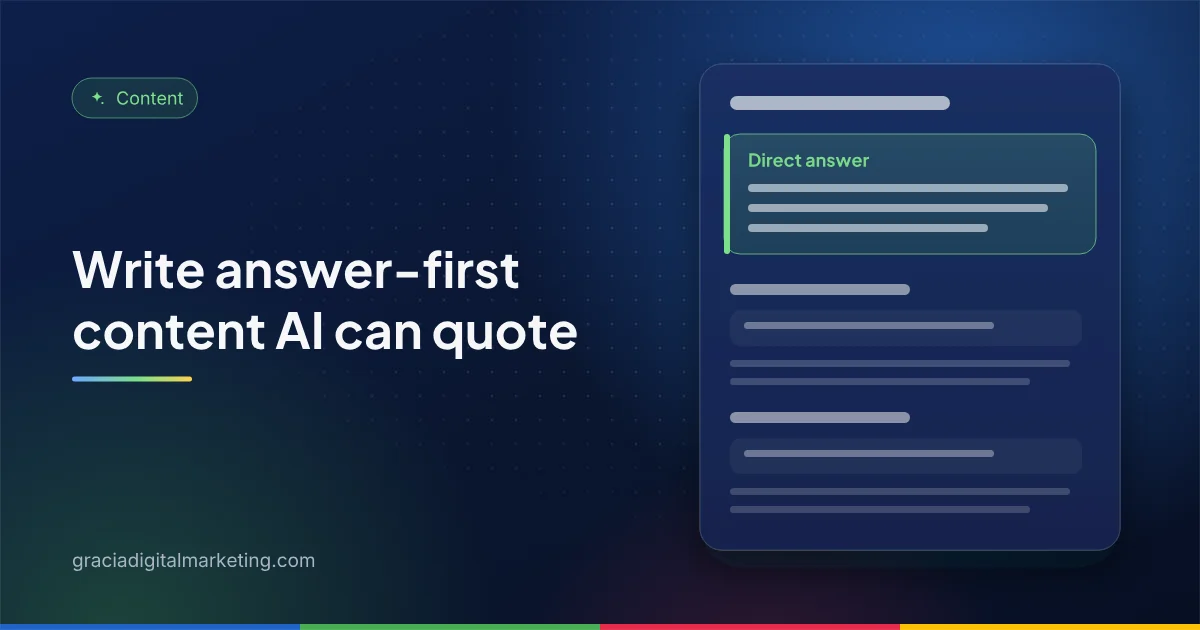
Answer-first content puts a short, direct answer to the reader’s question at the top of the page and at the start of each section, then adds the detail, evidence and nuance. It helps busy buyers, and it gives search engines and AI assistants a clear, self-contained passage they can quote and link to accurately.
Most B2B content still opens with scene-setting: market trends, a definition everyone knows, a paragraph about why the topic matters. Readers skim past it. AI systems, which assemble answers from passages across many pages, often skip it too. Answer-first writing fixes that without turning your content into robotic fragments.
Why does answer-first writing matter for AEO?
Because answer engines look for passages that answer a question clearly and stand on their own. A page that buries its answer gives them less to work with.
Bing’s Webmaster Guidelines recommend surfacing key information early, writing content that can be understood and verified on its own, and keeping each URL focused on one topic. Microsoft’s advertising team, in a guide to inclusion in AI search answers, describes how assistants such as Copilot parse pages into smaller pieces and assemble answers from several sources, and recommends descriptive headings, direct Q&A pairs, lists and tables.
Google takes a more relaxed line. Its AI optimization guide says you do not need to “chunk” content or rewrite it for AI, because its systems understand whole pages and synonyms. Both positions point to the same habit: write clearly for people, and the structure that helps them also helps machines.
What is the answer-first framework?
Five parts, in order: the question, the direct answer, the qualifiers, the evidence and the next step.
- The question. Use the buyer’s words in the heading where it reads naturally: “How long does a CRM migration take?”
- The direct answer. One to three sentences that answer it fully, even without the heading. For a hypothetical CRM consultancy: “Most of our mid-size CRM migrations take six to twelve weeks, depending on data volume, integrations and how much cleanup the old system needs.” Use your own real range.
- The qualifiers. When the answer changes: company size, industry, region, budget, regulation.
- The evidence. How you know: a process you run, a worked example, a source you cite, a screenshot of your own data.
- The next step. A related guide, a tool, or a way to talk to someone.
The direct answer should be your own honest view. If the real answer is “it depends”, say what it depends on in the same sentence.
What does answer-first look like in practice?
Compare a typical opening with an answer-first version of the same section.
| Typical pattern | Answer-first pattern |
|---|---|
| Heading: “Learn more about our approach” | Heading: “How does a managed SOC service work?” |
| Opens with “In today’s fast-paced digital landscape…” | Opens with what the service does, for whom, and the main trade-off |
| “Innovative, best-in-class solutions” | Named capabilities, integrations, regions and industries |
| Key answer hidden in a tab or accordion | Key answer visible in the page HTML |
| Specs only in a PDF or an image | Specs in HTML text or a table, with the PDF as an extra |
| Ends with “Contact us to learn more” | Ends with a specific next step and a related guide |
The last three rows come straight from Microsoft’s guidance, which warns that AI systems may not render content hidden in tabs or expandable menus, that PDFs lack the structure of HTML, and that information only in images is harder to interpret reliably. It also advises against vague terms like “innovative” without specifics.
How should you structure a full page?
Open with the page-level answer, follow with question-led sections in the order a buyer would ask them, and finish with an FAQ for the smaller questions.
- Title, H1 and description that agree. Microsoft notes that consistent titles, H1s and descriptions help AI systems understand scope.
- One H1, then H2s for the main questions and H3s for sub-points. Do not skip levels for visual effect.
- Short answer at the top of each H2, then detail. Many readers will only read these.
- Lists for steps and options, tables for comparisons. Use them when they genuinely make information easier to scan, not by default.
- A visible FAQ for related questions that do not deserve their own section. Our guide to schema markup for AEO explains how to mark it up honestly.
- Sources for any third-party fact, linked to the original.
How do you make passages self-contained?
Write each answer so it still makes sense if it is the only thing a reader sees: name the subject, avoid “this” and “it” without a reference, and include the key condition.
Compare “It usually takes about two weeks” with “Our onboarding for a new payroll customer with up to 200 employees usually takes about two weeks,” as a hypothetical payroll provider might put it. The second can be quoted anywhere without losing meaning. The same principle applies to names: refer to your company, product and service consistently so an assistant does not mistake them for separate things. We cover that in entity SEO for AEO.
What should you avoid?
- Writing for robots. Repeating keyword variants or adding fake questions makes the page worse for people, and Google says AI systems understand synonyms anyway.
- Artificial fragmentation. Splitting one topic into dozens of thin pages to chase every question risks Google’s scaled content abuse policy.
- Unsupported claims. Statistics without sources, invented case studies or vague superlatives undermine trust with readers and machines alike.
- Hidden instructions. Text aimed at AI systems rather than readers is treated as manipulation by Bing.
An editing checklist for answer-first content
- Can a reader find the answer to the title question within the first two sentences?
- Does every H2 start with a direct answer of one to three sentences?
- Would each answer make sense if quoted on its own?
- Are claims specific, with numbers or examples you can stand behind?
- Is every third-party fact linked to an original source?
- Is all important content visible in HTML, not only in tabs, PDFs or images?
- Do the title, H1 and meta description describe the same thing?
- Is it clear who wrote the page and why they know the subject?
- Does the page link to the next useful step, such as a related guide or service page?
Applying this to existing pages is often quicker than writing new ones. Start with the pages that already rank or get cited for your most valuable questions, then work outward. If you would like help, our AEO services include content rewrites, and our free audit will show where to begin. For context on why this matters, read what answer engine optimization is.
Frequently asked questions
What is answer-first content?
It is content that states the direct answer to a question at the start of a page or section, in plain language, before adding context, evidence and nuance. Readers get what they came for quickly, and search and AI systems can find a clear, quotable answer.
How long should a direct answer be?
There is no official length. A useful working range is one to three sentences, roughly 40 to 60 words for a page-level answer and shorter for section answers. It should make sense on its own if quoted without the rest of the page.
Does Google require content to be broken into chunks for AI?
No. Google says there is no requirement to break content into tiny pieces, and its systems can understand pages that cover several topics. Clear headings and direct answers help readers; artificial fragmentation does not.
Should every heading be a question?
No. Question headings work well when they match how buyers actually ask. Use descriptive statements where they read better, such as a step in a process or a section of a comparison.
Will answer-first writing reduce clicks to my site?
Sometimes a reader gets enough from the answer and does not click. In return, being the cited source builds visibility with buyers who do want depth. Give them a reason to continue: specifics, examples, tools and a clear next step.
Sources
- Bing Webmaster Guidelines
- Microsoft Advertising: Optimizing your content for inclusion in AI search answers (October 2025)
- Google Search Central: Optimizing your website for generative AI features on Google Search
- Google Search Central: Creating helpful, reliable, people-first content
- Google Search Central: Featured snippets and your website
- Google Search Central: Spam policies, including scaled content abuse