How to Measure AEO: AI Citations, Share of Answer and Pipeline
On this page
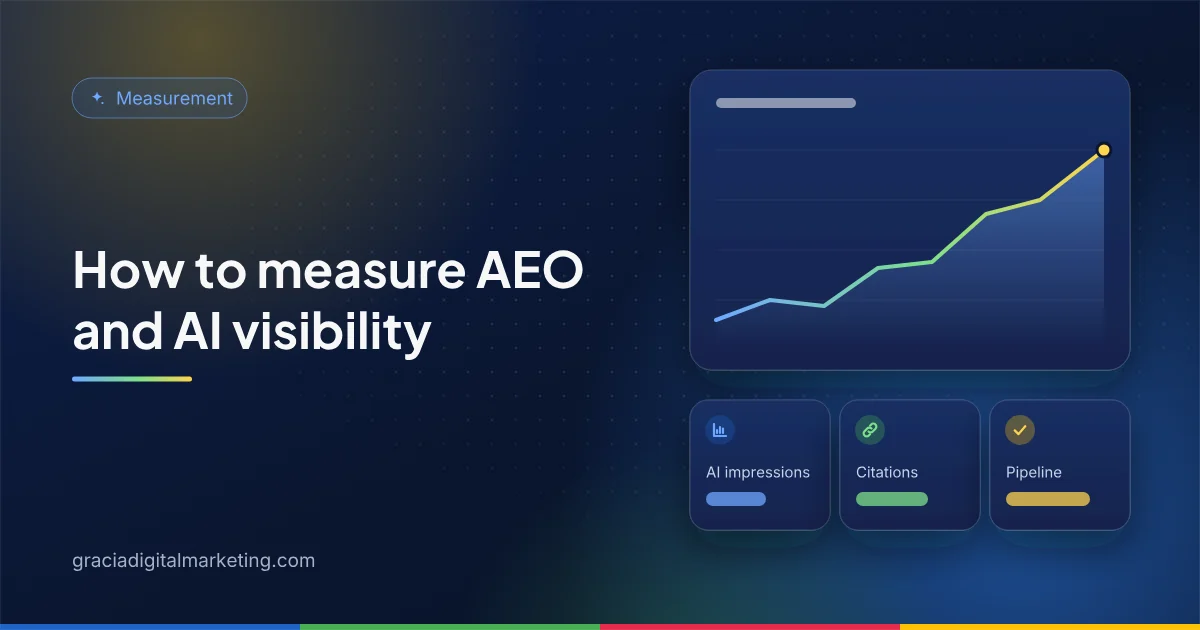
Measure AEO and AI search visibility in four layers: eligibility (can engines crawl and index you), visibility (AI impressions in Search Console and citations in Bing Webmaster Tools), presence (how often a fixed panel of buyer prompts cites or mentions you, and how accurately) and business impact (AI referral traffic and pipeline in your analytics and CRM).
Until recently, AI visibility was mostly screenshots and guesswork. In 2026 that changed: Google and Microsoft both now report AI impressions or citations directly. These reports do not show everything, and they do not cover ChatGPT, Perplexity or Claude, but together with a disciplined prompt panel and good CRM hygiene they give a credible picture.
What should you measure for AEO?
Track one or two metrics per layer, from technical eligibility through to revenue. Each layer explains the next.
| Layer | Metric | Source | Cadence |
|---|---|---|---|
| Eligibility | Key pages indexed; AI crawlers not blocked; generative AI setting included | Search Console, Bing Webmaster Tools, server logs | Monthly |
| Visibility | AI feature impressions; AI citations and cited pages | Search Console Generative AI performance report; Bing AI Performance | Monthly |
| Presence | Citation and mention rate on a fixed prompt panel; description accuracy | Manual or tool-based prompt tracking | Monthly |
| Engagement | Sessions and conversions from AI referrers | Web analytics | Monthly |
| Business impact | Leads and pipeline where AI was the source or an influence | CRM, form fields, sales notes | Quarterly |
How do you measure Google AI Overviews and AI Mode?
Use Search Console’s Generative AI performance report for impressions and the main Performance report for clicks, which already include AI features under the Web search type.
Google rolled the Generative AI performance report out to all sites on August 31, 2026. It counts an impression when a link to your site is shown in AI Overviews or AI Mode, and groups data by page, country, date and device. You can filter text queries separately from multimodal searches made with images, such as Google Lens or Circle to Search. Like the main Performance report, it is limited to 1,000 table rows and attributes most data to canonical URLs.
If you do not see the report, Google says the usual reasons are too few AI impressions or a site excluded from Search generative AI features in Settings. We cover that setting in how to get cited in Google AI Overviews.
How do you measure Microsoft Copilot and Bing AI answers?
Use the AI Performance report in Bing Webmaster Tools, which shows citations across Copilot, AI summaries in Bing and selected partners.
Launched in public preview in February 2026, the report shows total citations, average cited pages per day, grounding queries (the phrases the AI used to retrieve your content, shown as a sample), page-level citation counts and trends. In June 2026 Microsoft added four preview views: Intents and Topics, which classify the grounding queries; Citation Share, the percentage of citations your site received for a grounding query out of all citations shown for it; and Compare, which overlays a previous period. Microsoft stresses that these are observational metrics, not rankings or traffic share.
How do you measure ChatGPT, Perplexity and Claude?
There is no first-party citation report for most assistants, so combine referral analytics with a fixed prompt panel you track over time.
Referral traffic. In your analytics, create a channel or segment for AI assistant referrers, for example chatgpt.com, perplexity.ai, claude.ai, gemini.google.com and copilot.microsoft.com. Some visits arrive without a referrer, so this undercounts.
A prompt panel. Build a list of 30 to 50 questions your buyers actually ask, across awareness, comparison and vendor-selection stages. Each month, run them in the assistants that matter to your market and log:
- Whether your brand is mentioned, and whether your site is cited with a link.
- Which competitors and sources are cited instead.
- Whether the description of your company is accurate.
- Which of your pages are cited, if any.
Keep the wording, location and account settings consistent so month-to-month changes mean something. Answers vary between sessions, so look at the share of prompts over time, not single results.
Should you use third-party AI visibility tools?
They can save time on prompt tracking, but treat their numbers as directional estimates, not ground truth.
Many tools now run prompt panels at scale. That is useful, but each tool samples answers that change with phrasing, location and model updates. Google’s AI optimization guide warns that no third-party tool has access to its internal ranking or AI systems and advises evaluating tools’ advice against official guidance. Choose tools that show you the actual prompts and answers behind any score.
How do you connect AEO to pipeline?
Add a self-reported attribution field to forms, ask in sales calls, and tag AI-referred sessions so they flow into your CRM.
- Add “How did you hear about us?” as a free-text field on demo and contact forms. Answers such as “found you in ChatGPT” are exactly what you want to capture.
- Pass the first-touch referrer and landing page into your CRM with each lead.
- Ask sales to note when a prospect mentions an AI assistant.
- Report AI-sourced and AI-influenced pipeline quarterly, alongside organic search.
This is imperfect, but it is far more convincing to a leadership team than screenshots. For B2B software teams, our AEO for B2B SaaS guide shows which pages usually drive these conversations.
What does a monthly AEO report include?
- One chart each for Google AI impressions and Bing AI citations, with a three-month trend.
- The top cited or shown pages, and any new ones.
- Prompt panel results: mention rate, citation rate and accuracy issues found.
- AI referral sessions and conversions.
- Actions taken and next month’s priorities.
If you would like this set up for you, measurement is built into our AEO services and GEO services. A free audit is a good place to set your baseline, and our AEO audit checklist covers eligibility in detail.
Frequently asked questions
Can I see AI Overview impressions in Google Search Console?
Yes. The Generative AI performance report, available to all sites since August 31, 2026, shows impressions from AI Overviews and AI Mode by page, country, device and date. AI feature clicks and impressions are also included in the main Performance report under the Web search type.
What does Bing’s AI Performance report show?
It shows total citations, average cited pages per day, the grounding queries used to retrieve your content, page-level citation counts and trends across Copilot, AI summaries in Bing and some partner experiences. Intents, Topics, Citation Share and Compare were added in preview in June 2026.
How do I track traffic from ChatGPT and Perplexity?
Look for referral traffic from their domains, such as chatgpt.com and perplexity.ai, in your analytics. Not every visit carries a referrer, so combine this with a ‘How did you hear about us?’ field on forms.
Are third-party AI visibility tools accurate?
They can be useful for tracking a fixed set of prompts over time, but they sample answers that vary by session, location and model version. Google warns that no third-party tool has access to its internal ranking or AI systems. Use them for trends, not precise numbers.
What is a realistic AEO KPI for a B2B company?
Pick a small set: AI impressions in Search Console, citations in Bing, citation rate across a fixed panel of buyer prompts, accuracy of how assistants describe you, and AI-referred or AI-influenced pipeline in your CRM.
Sources
- Search Console Help: Generative AI performance report (Search)
- Search Console Help: Performance report (Search results)
- Google Search Central: AI features and your website
- Google Search Central: Optimizing your website for generative AI features on Google Search
- Bing Webmaster Blog: Introducing AI Performance in Bing Webmaster Tools (February 2026)
- Bing Search Blog: Intents, Topics, Citation Share and Compare (June 2026)